
Kearns City Directory Collections
The main Kearns city directory trail comes from R.L. Polk & Co. volumes in the University of Utah Marriott Library’s digital city-directory collection and related Utah Historical Society holdings. Identified suburban runs include 1957, 1958, 1959, 1960, 1962–73, 1974, 1975, 1976, 1977–78, 1979, and 1980. The metadata for the 1974 Salt Lake City Suburban directory names Kearns among its communities. That publisher geography is not the same as a modern city boundary.
| Collection | Years | Where Held | Access |
|---|---|---|---|
| R.L. Polk suburban city directories | Identified 1957–1980 runs | University of Utah / Utah Historical Society | Digital metadata and images |
| Salt Lake County Polk holdings | 1951–53, 1955, 1957–62 | County Archives | Written request or appointment |
| Reverse or criss-cross sections | Varies by volume | Directory volumes | Read address to name |
| Salt Lake City microfilm | 1861–1960 guide coverage | Library of Congress / library leads | Microfilm access varies |
Do not fill gaps with guesses. Utah CFA notes Library of Congress microfilm through 1960 and Polk gaps in 1943, 1945, and 1947. The last printed volume specifically covering Kearns was not established. Use the exact year and page that can be verified, then mark an absent year as an unavailable run rather than proof that a household was gone.
Open the Kearns Digital Directory Shelf
The University of Utah Marriott Library collection reports 232 directory records covering Salt Lake City, Salt Lake County, and nearby communities. Its suburban metadata is the useful Kearns layer. Search the item title and year, then note the publisher, community list, image page, and any scan or OCR limits. Utah Historical Society’s digital collections provide a second official route for directory and local-history material.
The Salt Lake County Library is a practical fallback. Its system reports 18 locations, two reading rooms, free library cards, and about two million items. Current Kearns branch access to licensed genealogy databases, obituary indexes, newspapers, and microfilm was not confirmed. Ask the branch before relying on a subscription or reader. For newspapers, the Utah Digital Newspapers route can be searched by name, address, organization, spouse, and date window, then checked against the original page.
Open the University of Utah directory collection for the digitized catalog route.
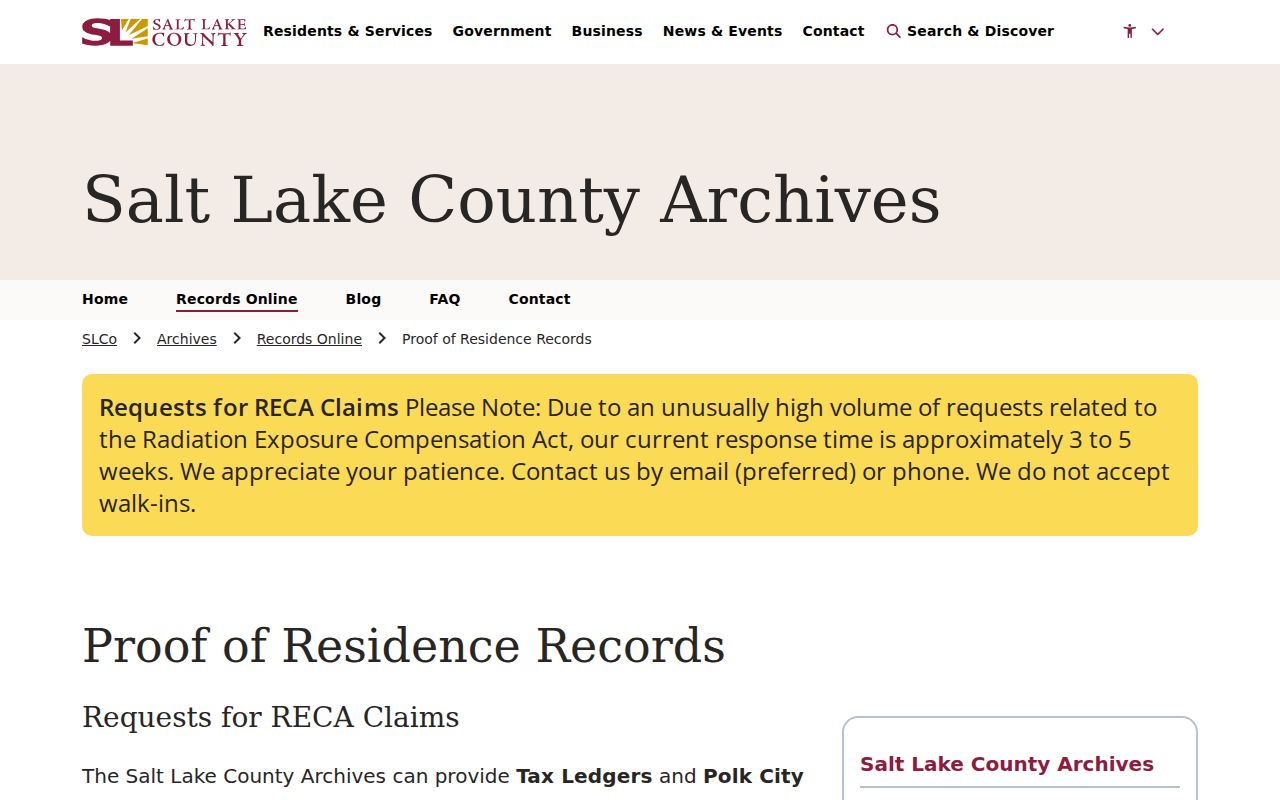
The local archive image points to the request path that matters when a digitized scan does not include the year or address needed.
Request County Directory Years
Salt Lake County Archives holds Polk directories for 1951–53, 1955, and 1957–62 as part of its proof-of-residence research. The request should name the exact street address, person or household name, and year. The Archives says the work takes 3–5 weeks because of demand. It is appointment-only, has no walk-ins, and prefers email, with phone help available at 385-468-0820.
Address history needs more than a current parcel number. A 1950s or 1960s street number may have changed or may no longer exist. Include the old address, nearby cross street if known, directory type, and each year to check. Ask whether the volume is alphabetic, suburban, or reverse. A focused request gives the archivist a usable search instead of an open-ended request to find a person.
Camp Kearns in Directory Context
Camp Kearns adds a useful history clue when an ordinary residential search comes up empty. The camp operated from 1942 through 1946. The Kearns Photograph Collection, dated 1949–50, captures the change that followed: land-sale campaigns, street and utility work, planning, families in advertisements, and a fire station. Those images do not replace a directory entry, but they can supply a place name or development date for a newspaper and archive search.
Kearns’ record labels also changed. A pre-2024 item may say Kearns Metro Township or unincorporated Salt Lake County, while today’s city pages say City of Kearns. Search both labels and keep the source geography beside the person’s name. This is why city directories can be strong family-history evidence without being a complete modern resident list.
Reading a Kearns City Directory Entry
A Kearns city directory entry may sit in more than one sequence. The alphabetic name section is the natural start when a surname is known. A street or reverse section works when an address is known. Later volumes may include advertisements, institutions, telephone material, and abbreviation keys. Utah’s architectural guide says directories often list names, addresses, and occupations, and many later volumes offer both name and address arrangements.
| Name | Surname and given name or initial; spouse or family notation may follow. |
|---|---|
| Occupation | Occupation and sometimes the employer or business. |
| Address | House number and street, with apartment or unit when supplied. |
| Owner or renter mark | Some runs distinguish homeowner and occupant; confirm the volume key. |
| Widow notation | A widow or deceased-spouse mark can support a family-history timeline. |
- Criss-cross section
- The street-order portion that lets an address lead to a listed occupant.
- Householder index
- An index organized around household names or heads rather than every person present.
- Abbreviation key
- The volume’s guide to short forms and symbols; read it before interpreting a mark.
Pair Kearns Directories With Census
Census schedules can fill the long gaps between city-directory years, but they follow enumeration geography rather than today’s Kearns city line. The 72-year release rule also means the newest public schedule will not match the newest directory. Compare the household name, age, relationship, street or district, and nearby entries. Keep the census date and directory publication date in separate columns.
Utah Digital Newspapers can add a dated notice, obituary, organization mention, or address clue. Save the newspaper title, date, and page, then check the event against a death record, probate index, deed, or other source. A newspaper hit is a lead, not proof of a current Kearns residence.
Kearns Historical Society Sources
The Kearns Historical Society, founded in 1998, focuses on Camp Kearns and the community’s World War II origins. Its collection accepts documents, photographs, and artifacts connected to personal ties and donations. The official Utah Museums Directory listing is the contact route. No public membership roster was located, so the Society is a heritage research lead rather than a resident list.
The Kearns Photograph Collection at the Utah Historical Society covers 1949–50 development and can supply a place name when a directory is silent. Use its finding aid, item date, and access or copyright terms. An image of a family or street scene needs a source citation before it is used to identify anyone.
Trace Kearns Families Across Years
Use a Kearns city directory as a dated snapshot. Start with the first year that fits the person or address, then compare the same name in nearby volumes. Record every address, spouse notation, occupation, and publisher label. Flip to the criss-cross section when the street is known. Pair a directory with a census year, but keep the dates distinct: a directory may be compiled at a different time than the census enumeration.
- Find the first plausible name or address entry and save its year and page.
- Follow the person through identified Polk runs, noting moves and spelling changes.
- Read the reverse section to test the street and nearby households.
- Pair directory years with census schedules, respecting the census release rule.
- Use Utah Digital Newspapers, an obituary, probate, or a death record to close a gap.
A name that disappears may reflect a move, death, a missing volume, a changed index form, or a publisher’s coverage choice. Check a later directory, newspaper notice, deed, tax card, or probate index before choosing one explanation. The full city-directory trail is historical evidence, not proof of a present Kearns address.